Web and mobile apps
Web and mobile applications, business tools, SaaS and features. A senior team, equipped with its own AI agents, to design and deliver with you.
From scoping to handover, with the same people.
The people who design your product build it and hand it over. You stay the owner of the code, the documentation and the access.
What kind of applications?
A few examples, not a closed list. Web, iOS or Android: the platform is chosen after the need.
Consumer application
A web and/or mobile application that the public downloads or opens in a browser, with accounts, notifications and payment…
Internal business tool
Replace spreadsheets and back-and-forth, track operations, enter data in the field even offline, and sync with the office…
Client or partner portal
A space where your clients follow their file, upload documents, book or pay…
Platform or marketplace
Connect two audiences, with accounts, payments, messaging and tracking…
Product to sell (SaaS)
Software you publish, with subscriptions, multiple customers and regular updates…
And your case?
If your need isn’t here, that’s normal: each application starts from the way you work. Describe it to us, and we’ll tell you what to build first.
Anatomy of an application
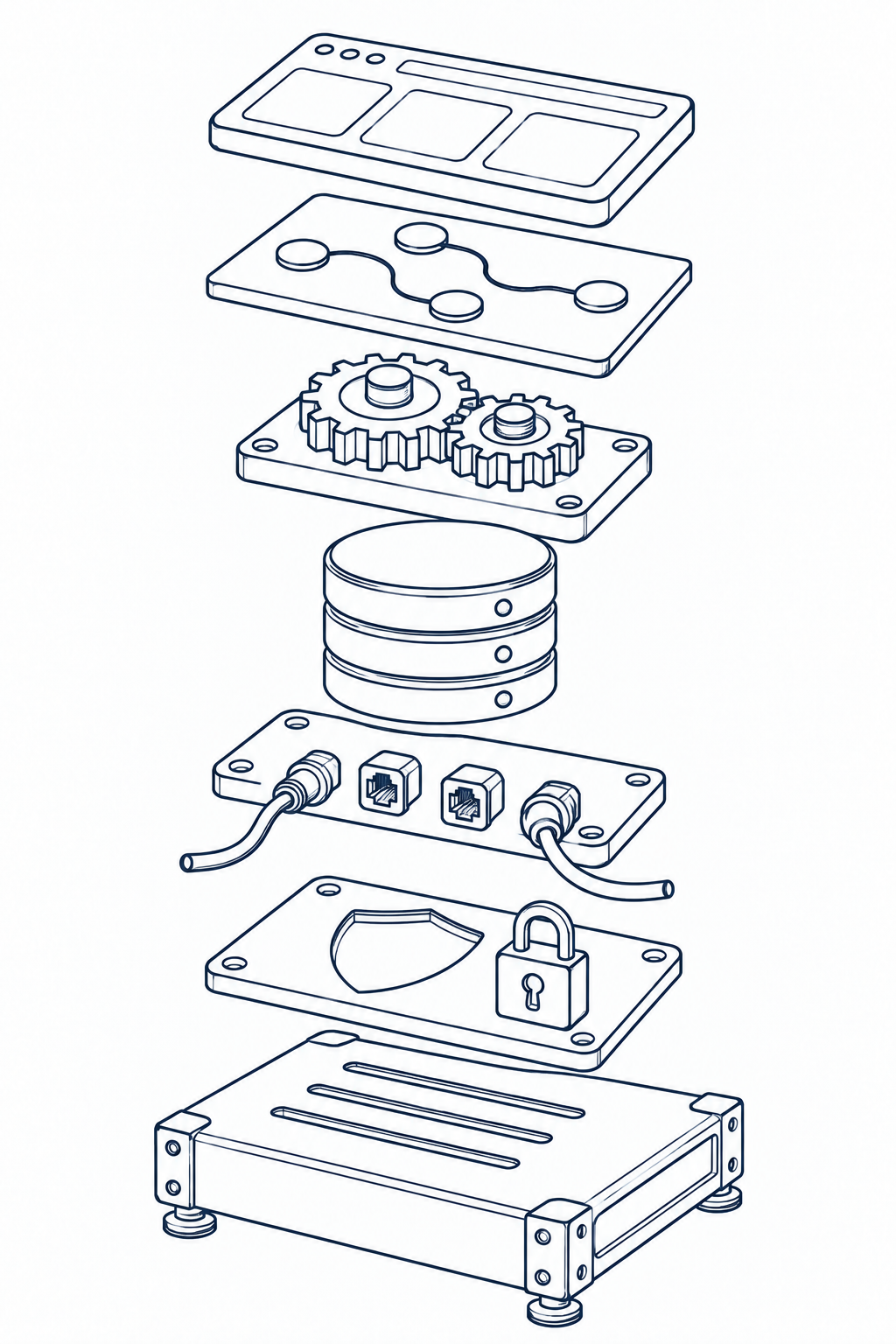
An application is more than a screen. Behind each journey is a stack of layers that we design together. Getting them right from the start avoids rebuilding everything later.
The interface
What your users see and touch: accessible screens and journeys, on the web and on mobile.
The journeys
Sequences of actions designed for your use, tried on a mockup before being built.
The business logic
Your rules, your calculations and your validations, written once and applied everywhere.
The data
Where the information lives, how it is structured, backed up and exportable.
The integrations
Connections to your existing tools: ERP, CRM, payment, messaging.
Access and security
Who can see and do what, and how the data is protected.
Hosting and monitoring
Where the application runs, how it is updated, monitored and backed up.
Our engagements
Four types of engagements, from the simplest to the broadest.
A new application
Web, iOS or Android, depending on the need: from the first version to going live.
A feature
An addition to an application that already exists, with acceptance criteria written in advance.
Taking over an existing application
A review of the code, the data and the access, then we evolve it or rebuild part of it.
Your agentic development pipeline
We equip your teams, developers or not, with the same pipeline we use to deliver our own features, and we train them to use it.
Our work
Products already in users’ hands.
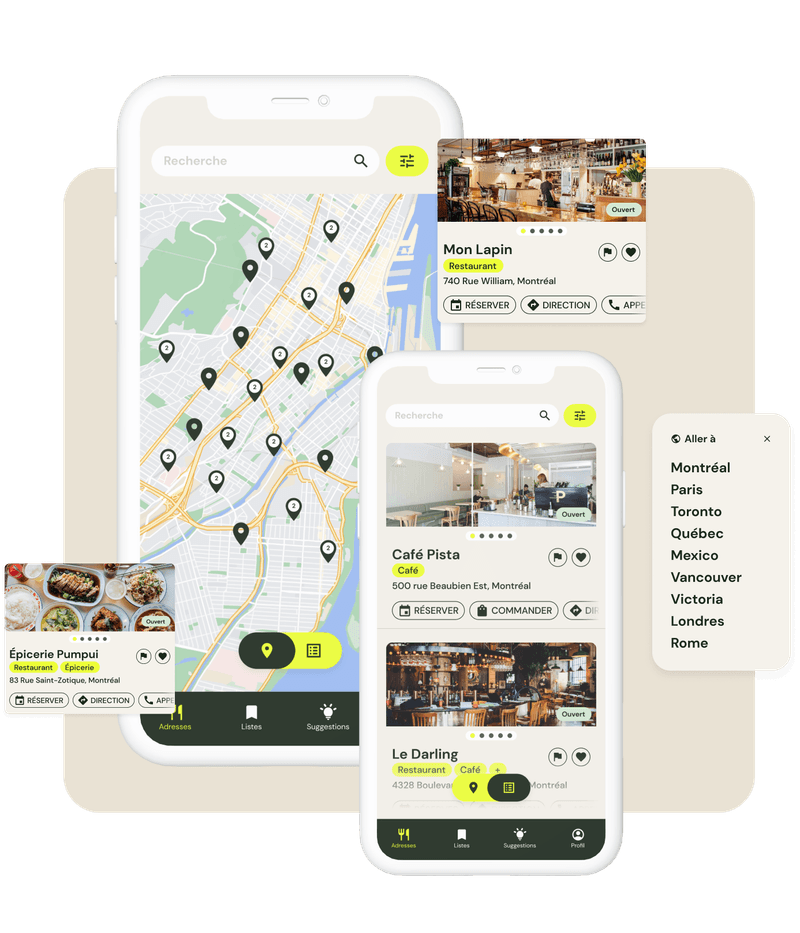
Tastet
A food guide, a map and an app to discover the good addresses in Montréal.
Web and IoT appMolluscan Eye
A water quality monitoring platform using mollusks fitted with sensors.
Web app and back officeCoup de clé
The appointments, technicians and job tracking of a home repair network.
Our services
Three ways to work together, from the plan to your team's independence.
Scoping
A review of your tools, your business and your opportunities. You leave with an action plan and a first concrete deliverable: a prototype, a mockup or a specification.
Learn more
Build
We build and test your application or AI system, with an agreed scope and budget.
Learn more
Training
Training that starts from your tools and how you use them.
Learn moreFrequently asked questions
How long does a first version take?
It depends on the scope. Scoping sets a breakdown into stages and a schedule before production starts. We prefer a useful, tight first version to a project that is too broad.
Can we start small?
Yes. Scoping defines the smallest version that brings value, and what follows is decided stage by stage, based on what your users say.
Web or mobile application: which to choose?
It depends on where your users are and what they do. A web application that adapts to all screens is often enough to start. Scoping settles it with you.
Can you take over an existing application?
Yes. We start with a review of the code, the data and the access, then we propose either to evolve it or to rebuild part of it.
Does the code belong to me?
Yes. The code, documentation and access are handed over to you as we go through the stages. You can carry on alone or with another partner.
What happens to the application after it goes live?
It’s yours. You evolve it with your team, or you entrust each change to us, priced at a fixed price.
What if my needs change along the way?
The work moves in short, costed stages: you can change course at the end of a stage without losing what has been built.
Do you use AI to develop?
Yes. Agents write, test and review the code, under the responsibility of people who design and approve. Acceptance criteria are written in advance and checked before the invoice.
The next step
What are we moving forward together?
An idea, an existing product, a task that takes too long. Tell us where you're starting from.
Let's talk about your projectA first conversation to understand your context.
Keep exploring
Based on your profile
StartupsSMEs and mid-sized companiesLarge enterprisesInstitutions and organizations